


Sports Betting Markets in Gembet: Read the Rules Before You Bet
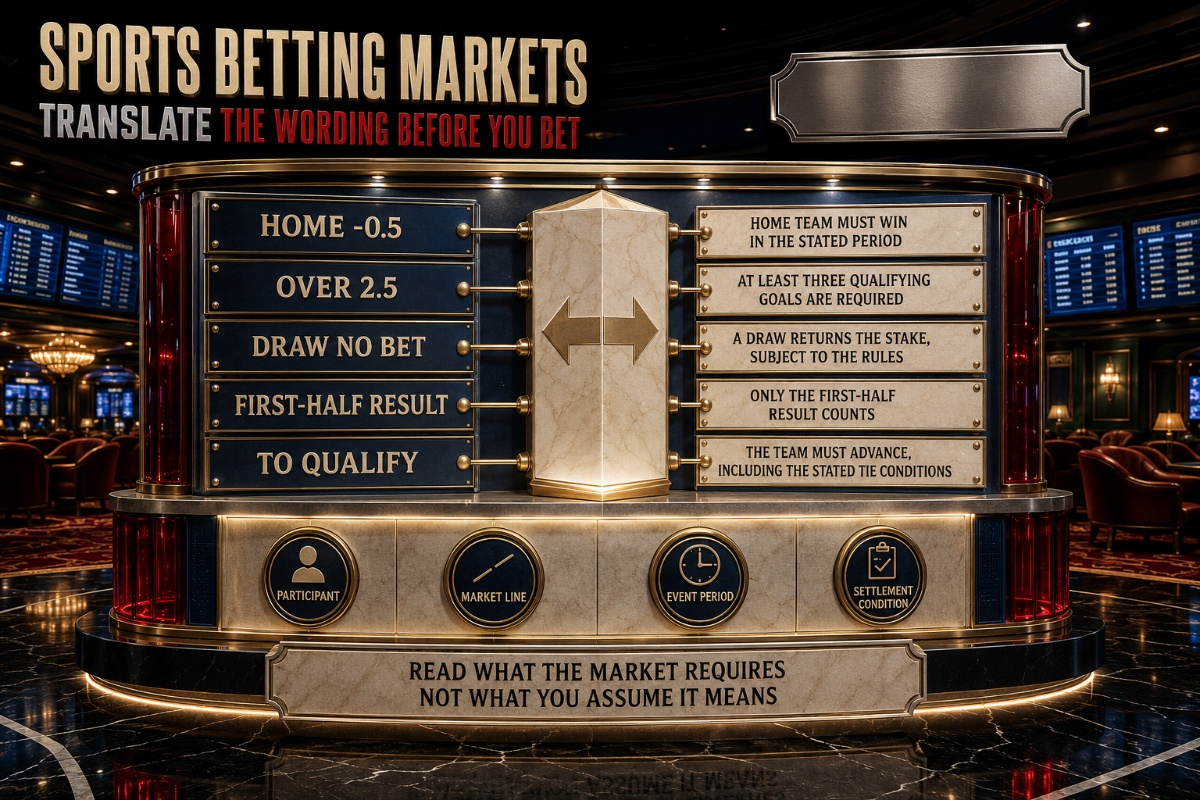
Sports betting markets can look familiar while using different wording, periods and settlement rules. A selection labelled “match winner” may cover regulation time in one place and include extra time in another. Before placing a bet, players need to understand exactly what result the market is asking for.
This article takes a different approach from a general market guide. Instead of listing every market type, it shows how to translate sports betting markets into plain language, compare similar-looking options and identify the rule that decides settlement.
Sports Betting Markets Should Be Rewritten as One Sentence
The fastest way to understand sports betting markets is to rewrite each selection as a complete sentence. “Home team to win” becomes “the home team must be ahead when the stated match period ends”. “Over 2.5 goals” becomes “the match must produce at least three qualifying goals within the stated period”.
If the sentence does not identify the participant, period, line and required result, the market has not been understood yet.
Start With the Market Period
Sports betting markets become easier to separate once the time window is identified first.
Many mistakes happen because sports betting markets cover different time windows. A result market may apply to regulation time, the first half, one quarter, one set, one map or the full event including overtime.
Before comparing prices, locate the period label. In football, “match result” often refers to regulation time, while “to qualify” concerns which team advances. In basketball, a full-game market may include overtime, but a regulation-only option may not. The exact rules should always be checked in the active market.
Read the Line as Part of the Market Name
Sports betting markets are not defined by category alone. The line changes the condition. Over 2.5 and over 3.0 are different selections. A handicap of -0.5 is not the same as -1.0.
Record the full market in this order:
- event;
- market type;
- participant or side;
- line;
- period; and
- displayed price.
Learn the Three Settlement Outcomes
Sports betting markets should be compared by every possible settlement, not only by the desired result.
Many sports betting markets can settle as a win, loss or void. Some line-based markets can also create a push, where the stake is returned because the result lands exactly on the stated number.
For example, an under 3.0 goals selection may win with zero, one or two goals, push with exactly three and lose with four or more, subject to the current rules. By contrast, under 2.5 cannot push because a football score cannot produce half a goal.
Understanding this distinction helps players compare the protection offered by whole, half and quarter lines.
Quarter Lines Split One Stake Into Two Conditions
Quarter-line sports betting markets combine two adjacent conditions within one selection.
Some handicap and total sports betting markets use quarter lines such as -0.25, +0.75 or over 2.25. These generally split the stake across the two neighbouring lines.
A -0.25 handicap can be understood as half the stake on 0 and half on -0.5. An over 2.25 total can be understood as half on over 2.0 and half on over 2.5. This creates possible half-win or half-loss settlements.
Do Not Assume Similar Labels Mean Identical Rules
Sports betting markets can use labels such as “winner”, “moneyline”, “match result” or “to qualify”. These may look interchangeable but can cover different periods or settlement conditions.
Likewise, “both teams to score” may apply to the full match, first half or a selected period. Player markets may require a starter, any participation or a minimum amount of playing time depending on the rules.
Compare the rule attached to the exact selection, not the general meaning of the label.
Identify What Counts as an Official Result
Sports betting markets also depend on when an event becomes official for settlement.
Settlement depends on the result source and the point at which the event is treated as complete. Sports betting markets may be affected by abandonment, retirement, postponement, disqualification or a later correction.
Before placing a bet on an event with interruption risk, check:
- how much of the event must be completed;
- whether a postponed event remains open;
- how retirements are treated;
- whether later governing-body changes affect settlement; and
- which result source is used.
Player Markets Need Participation Rules
Player sports betting markets require more than a performance opinion. The player may need to start, enter the event, record a minimum amount of action or remain active long enough for the wager to stand.
Translate a player selection into two sentences:
- What performance must occur?
- What participation condition must be met for the market to remain valid?
This is especially useful for football line-ups, basketball minutes, tennis retirements and esports roster substitutions.
Understand Whether Overtime or Extra Time Counts
Sports betting markets must state whether play beyond regulation is included.
Sports betting markets can settle differently after regulation ends. A football match-result market may exclude extra time, while a qualification market includes the final advancement outcome. Basketball totals and handicaps may include overtime unless a regulation-only label is shown.
Compare Market Protection, Not Just Price
Two sports betting markets can express the same general opinion with different protection. A match-result selection may require a win, draw no bet may return the stake on a draw, and double chance may cover two outcomes.
The lower price on the protected option reflects the additional outcome coverage. Compare what causes each selection to win, lose or return the stake. That comparison is more informative than choosing the largest number automatically.
Watch for Correlated Selections
Sports betting markets can look different while depending on one shared assumption.
Several sports betting markets may rely on the same match story. Home win, home -0.5 and home to score first can all fail when the home side performs poorly. Adding all three does not create three independent opinions.
Ask whether the selections probably lose for the same reason. If they do, treat them as one concentration of risk rather than separate research conclusions.
Use a Plain-Language Market Card

A simple card can make sports betting markets easier to compare:
| Field | Question |
|---|---|
| Event | Which exact fixture or contest is covered? |
| Period | When does the market begin and end? |
| Condition | What must happen for the selection to win? |
| Line | Is there a handicap, total or threshold? |
| Protection | Can the result create a void, push or partial return? |
| Participation | Does a named player need to start or take part? |
| Interruption | What happens after postponement, retirement or abandonment? |
Use Gembet as the Final Wording Check
Sports betting markets should reach the platform only after their wording has been translated and checked.
On Gembet, open the event and compare the selected market with the plain-language card. Check the participant, line, period and current displayed price before moving it to the bet slip.
Similar team names, alternate periods and nearby lines can create avoidable mistakes when the slip is read too quickly.
A Pre-Bet Translation Routine
This routine turns sports betting markets into clear, testable conditions before the stake is entered.
- Open the exact event.
- Copy the full market title and line.
- Rewrite it as one sentence.
- Identify the period and whether overtime counts.
- List win, loss, push and void outcomes.
- Check participation or interruption rules.
- Compare related markets for duplicated risk.
- Confirm the final wording on Gembet.
If the selection cannot be explained without using vague phrases such as “probably covers” or “should count”, it is not ready.
Questions Beginners Often Ask
Are moneyline and match result always the same? No. The label may cover different periods depending on the sport and market.
What is a push? It is a settlement where the result lands exactly on a whole-number line and the stake is returned, subject to the rules.
Does extra time count? Only when the market wording or rules include it.
What happens if a player does not start? The answer depends on the participation rule attached to that market.
Can a price change without the market changing? Yes. The price can move while the line stays the same, or both can change. Record both.
Sports Betting Markets Become Easier When the Wording Is Clear
Sports betting markets are not difficult because there are many names. They become difficult when the exact period, line, participation rule or settlement condition is ignored.
The practical skill is translation. Rewrite the selection, identify what counts, map every possible settlement and compare only markets that ask the same question. Use Gembet as the final wording and slip check, then keep the stake within a fixed entertainment budget.
A market is understood when the player can explain why it wins, why it loses and when it is void.
Highest odds in SG for EPL & Champions League. 5-minute fast payouts via PayNow.

