


FIFA World Cup Champion History: The Greatest Finals and What Made Them Historic
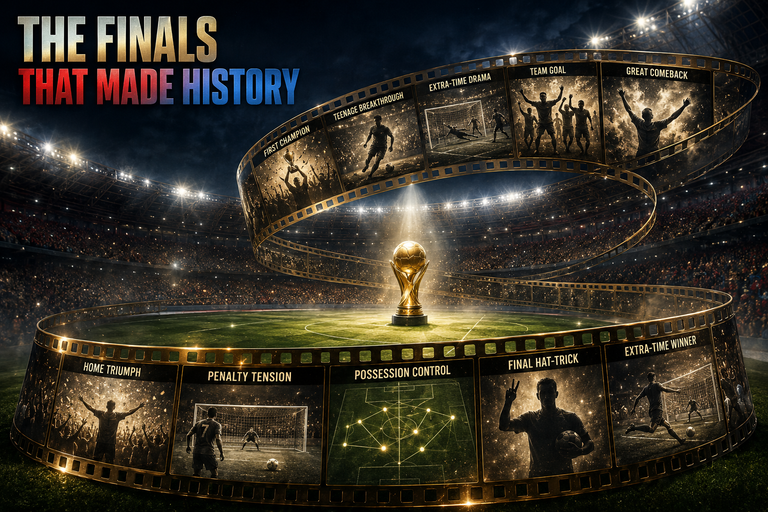
FIFA World Cup history is often told through trophy winners, but the greatest finals reveal far more than the name of each champion. They show how teams respond to pressure, how tactical plans change during a match, and how one goal or individual performance can shape football history for generations.
Some FIFA World Cup finals became historic because one team produced an overwhelming performance. Others are remembered for comebacks, disputed moments, penalty shoot-outs, extra-time goals, or the arrival of a player who would define an era.
The latest chapter came in 2026, when Spain defeated Argentina 1–0 after extra time. That final was different from the six-goal drama of 2022, yet it showed that patience, control, and defensive concentration can be just as historic as a high-scoring contest.
A Final Is Remembered for the Story, Not Only the Score
A FIFA World Cup final carries a level of pressure that an ordinary international match cannot reproduce. Players know that one mistake may follow them for the rest of their careers, while one successful moment can make them permanent national heroes.
The greatest finals usually contain at least one of these elements:
- A first title or historic national breakthrough
- An exceptional individual performance
- A comeback that changes the emotional direction of the match
- A tactical idea that influences later football
- An extra-time or penalty conclusion
- A moment that remains debated decades later
The following matches did not all succeed in the same way. That is precisely why they remain important.
Uruguay 1930: Where the FIFA World Cup Final Story Began
The first FIFA World Cup final placed Uruguay against Argentina in Montevideo. Argentina led 2–1 at half-time, but Uruguay recovered to win 4–2 and become the competition’s first champion.
The match immediately established several themes that would define later finals: regional rivalry, national pressure, tactical adjustment, and the possibility that control can change completely after the interval.
Uruguay succeeded because it did not panic after falling behind. The hosts increased their attacking pressure and scored three unanswered second-half goals.
The importance of this final extends beyond the result. Every later FIFA World Cup champion followed the path first created at the Estadio Centenario.
Italy 1938: Defending the Title in a Changing Football World
Italy defeated Hungary 4–2 in the 1938 FIFA World Cup final and became the first nation to retain the title. Winning consecutive tournaments required more than repeating the same successful formula.
Hungary possessed significant attacking quality, but Italy combined clinical finishing with a disciplined collective structure. The champions understood when to attack quickly and when to protect their shape.
Why they succeeded was closely connected to experience. Several Italian players already understood the pressure surrounding the final stage, and the team entered the match with a clear tactical identity.
The victory made Italy the first international football dynasty of the tournament era.
Brazil 1958: Pelé Arrives on the Largest Stage
Brazil’s 5–2 victory over hosts Sweden became one of the most important FIFA World Cup finals because it introduced Pelé to a global audience.
Only 17 years old, Pelé scored twice in the final. His first goal, involving an audacious flick over a defender before a composed finish, became one of the defining images of his early career.
Brazil succeeded because its creative players operated within a balanced structure. The team could attack through wide areas, combinations, individual dribbling, or rapid changes of direction.
The final delivered Brazil’s first FIFA World Cup title and began the country’s transformation into the competition’s most successful nation.
The 1958 final was more than a first title. It marked the moment Brazil’s football identity became a worldwide reference.
England 1966: Extra Time, Controversy, and a Historic Hat-Trick
England’s 4–2 extra-time victory over West Germany remains one of the most discussed FIFA World Cup finals.
The match was tied 2–2 after 90 minutes. Geoff Hurst then struck a shot that hit the underside of the crossbar and bounced near the goal line. The goal was awarded, although debate over whether the ball completely crossed the line has continued for decades.
Hurst scored again late in extra time to complete the first hat-trick in a men’s FIFA World Cup final. Kylian Mbappé later matched that achievement in 2022.
England succeeded through direct attacking, physical strength, midfield work, and the ability to respond after conceding. The title remains the country’s only men’s world championship.
Brazil 1970: A Final That Looked Like a Football Exhibition
Brazil defeated Italy 4–1 in 1970 with a performance that is still used as a reference point for attacking football.
The FIFA World Cup final was competitive for much of the first half, but Brazil gradually created more space through movement, passing, and individual skill. Pelé opened the scoring, and Brazil eventually overwhelmed an Italian team that had endured a demanding semi-final.
The final goal became especially famous. A patient passing move ended with Pelé laying the ball into the path of Carlos Alberto, who arrived at speed and finished powerfully.
Brazil succeeded because the team did not rely on one route to goal. Creativity existed throughout the side, and opponents could not close every passing lane or individual threat.
This was Brazil’s third title, allowing the nation to retain the Jules Rimet Trophy permanently.
Argentina 1986: A Comeback Nearly Changes Maradona’s Ending
Argentina appeared to be in control of the 1986 FIFA World Cup final after taking a 2–0 lead against West Germany. The match then changed dramatically.
West Germany scored twice from set-piece situations to equalise, placing Argentina’s title under serious threat. The defining response came when Diego Maradona produced the pass that released Jorge Burruchaga for the winning goal.
The final did not contain Maradona’s most famous goals of the tournament, but it completed one of the greatest individual campaigns in football history.
Argentina succeeded because the team remained composed after losing its advantage. Rather than retreat completely, it found one final attacking solution through its most influential player.
France 1998: A Home Final Becomes a National Breakthrough
France entered the 1998 FIFA World Cup final seeking its first title and faced defending champion Brazil. The expected close contest instead became a 3–0 French victory.
Zinedine Zidane scored two first-half headers from corners, changing the tactical demands of the match. France could then protect central areas and force Brazil to chase the game.
The hosts succeeded through defensive organisation, midfield control, set-piece preparation, and an ability to handle the emotional pressure of playing at home.
The final transformed Zidane into a national icon and made the team a symbol of a changing France. Its historical significance therefore extended beyond football tactics.
Italy 2006: A Final Remembered Through Contrasting Emotions
The 2006 FIFA World Cup final between Italy and France contained an early penalty, an equaliser, extra time, a red card, and a shoot-out.
Zidane gave France the lead with a chipped penalty before Marco Materazzi equalised. The defining incident came in extra time when Zidane was dismissed after striking Materazzi with his head.
Italy converted all five of its penalties and won the shoot-out 5–3.
Why they succeeded was partly explained by defensive resilience and emotional control. Italy had conceded only two goals during the entire tournament, and its players remained composed during the shoot-out.
The final remains historic because one player’s glorious career ended in controversy while another country claimed its fourth title.
Spain 2010: One Moment Rewards Years of Possession
Spain’s meeting with the Netherlands in the 2010 FIFA World Cup final was tense, physical, and far less fluid than many of Spain’s best performances.
The match remained goalless through normal time. Andrés Iniesta finally scored in the 116th minute, giving Spain its first world title.
Spain succeeded because it stayed committed to its central principles despite the difficult rhythm of the match. The team continued circulating the ball, controlling space, and waiting for an opening instead of abandoning its identity.
The final became historically important because possession-based football reached its highest international achievement. It also completed Spain’s remarkable sequence of major tournament victories around that period.
Argentina 2022: The Final That Refused to End
The 2022 FIFA World Cup final between Argentina and France produced one of the most dramatic sequences in tournament history.
Argentina led 2–0 and appeared in control before Kylian Mbappé scored twice in rapid succession. Lionel Messi restored Argentina’s lead in extra time, only for Mbappé to complete his hat-trick with another penalty.
The match ended 3–3 before Argentina won the shoot-out 4–2.
It belongs among the greatest finals because it repeatedly appeared settled and then changed direction. Messi finally won the trophy, while Mbappé became only the second player to score a hat-trick in a men’s FIFA World Cup final.
Argentina succeeded through a strong opening plan, midfield aggression, Messi’s influence, goalkeeper Emiliano Martínez’s decisive interventions, and composure during the shoot-out.
Spain 2026: Control, Patience, and One Extra-Time Goal
The 2026 FIFA World Cup final added a very different type of classic. Spain defeated Argentina 1–0 after extra time at New York New Jersey Stadium.
Argentina entered the final after scoring at least twice in every earlier match of its campaign, yet Spain prevented the defending champion from recording a shot on target across 120 minutes.
Ferran Torres scored the decisive goal in the 106th minute. Spain continued controlling territory and creating pressure without becoming tactically reckless.
The final was historic because it delivered Spain’s second world title and ended Argentina’s reign. It also demonstrated that one of the greatest finals does not require several goals. Tactical control, defensive precision, and the pressure of a single decisive moment can create their own drama.
The confirmed result and match highlights are available in the official FIFA World Cup 2026 final report.
Four Ways a Final Becomes Historic
The match introduces a new champion
Uruguay 1930, Brazil 1958, France 1998, and Spain 2010 carried special importance because each delivered a country’s first FIFA World Cup title.
One player produces an unforgettable performance
Pelé in 1958, Geoff Hurst in 1966, Zidane in 1998, Messi and Mbappé in 2022 all became inseparable from the finals in which they appeared.
The tactical story influences later football
Brazil’s attacking movement in 1970 and Spain’s possession control in 2010 became reference points beyond their own tournaments.
The result remains uncertain until the final moments
Extra time and shoot-outs increased the drama of 1966, 2006, 2010, 2022, and 2026. The trophy remained undecided long after the scheduled 90 minutes.
The Finals That Changed Their Champions’ Identities
A championship final can change how an entire football nation is perceived.
Brazil’s 1958 success began its global reputation for creative attacking football. England 1966 became a permanent reference point because the country has not repeated the achievement. France 1998 created its first world champion and transformed several players into national symbols.
Spain 2010 validated a possession-based identity, while Argentina 2022 became the final chapter in Messi’s pursuit of the trophy. Spain 2026 then added a second title through a more direct and defensively controlled version of Spanish football.
This is why FIFA World Cup champion history cannot be separated from the finals themselves. The final explains not only who won, but what the victory came to represent.
How to Compare Finals From Different Eras
Comparing FIFA World Cup finals requires context. The rules, tournament size, substitutions, pitch quality, travel, sports science, tactical analysis, and television coverage have all changed.
A final from 1930 should not be judged only through the same statistical standards used for a modern match. Early teams operated with different preparation, equipment, and tactical information.
The better questions are:
- How difficult was the opponent?
- How did the champion respond to pressure?
- Did the match produce a tactical or cultural legacy?
- Was there an exceptional individual performance?
- How uncertain was the outcome?
Those questions explain why low-scoring and high-scoring finals can both deserve historical recognition.
What Historical Finals Cannot Predict
Historical results can help football readers understand tactics, pressure, and tournament development. They cannot reliably predict a future champion or final.
Players reviewing FIFA World Cup markets through Gembet should not assume that a nation will repeat an old pattern simply because it succeeded in a previous tournament. Squads, managers, opponents, formats, and conditions change.
Likewise, a high-scoring previous final does not make another high-scoring match more likely. Each final must be analysed using current evidence.
Why These Finals Still Matter
The greatest finals survive because they contain stories that statistics alone cannot preserve. Uruguay’s first triumph, Pelé’s arrival, Hurst’s disputed goal, Brazil’s flowing attack, Maradona’s decisive pass, Zidane’s contrasting final appearances, Iniesta’s extra-time strike, Messi’s coronation, Mbappé’s hat-trick, and Spain’s 2026 control all represent different parts of FIFA World Cup history.
Readers encountering historical or future tournament markets on Gembet should use these matches as context rather than prediction. The drama of an old final does not guarantee the pattern of a new one.
The enduring lesson is that champions succeed in different ways. Some dominate from the opening whistle. Some survive a comeback. Some wait for one opening in extra time. Others remain calm when the title depends on penalties.
That variety is why the FIFA World Cup continues to produce football memories that last far beyond the final whistle.
Highest odds in SG for EPL & Champions League. 5-minute fast payouts via PayNow.

